

What are they and what should I be using?
I’m not sure if the perception I had about irons is a shared one when I say – good players use blades and not cavity backs – but this is an idea I picked up along my golf journey which isn’t necessarily true. Two factors moulded this perception; firstly, I didn’t know what actually qualifies an iron as a blade, and secondly, I didn’t know there was such a thing as a ‘refined’ cavity back. Once again, I looked to Mark O’Mahony from Titleist to enlighten me about classifying irons and how the characteristics of their categories vary in order to benefit particular players. As a guide, I will use Titleist’s iron models to clarify the different shapes and what strengths they bring to a golfers bag. We provide a full custom fitting service here at the Academy so we hope this helps clear things up!
Blade
620 MB – This is your traditional blade, or ‘muscle back’. It’s sleek in shape, without any metal removed from the back. This club has a smaller sweet spot; requiring the player to have greater consistency when it comes to hitting the sweet spot. Although it’s a less forgiving club, this design provides the player with tons of feel and is the easiest tool to manipulate the ball flight with.
Who uses these: Webb Simpson
620 CB – This is an inbetweener, as I like to call it. It’s not a straight blade, but it’s not a cavity back either. I like to call it a semi-blade, which may not be the correct terminology but might help you classify the shape of irons easier. Although it has some metal removed from the head, it’s minimal. It’s still sleek in shape but it’s design offers a little more stability in comparison to the MB, while still allowing the player to manipulate their ball flight easily.
Who uses these: Adam Scott
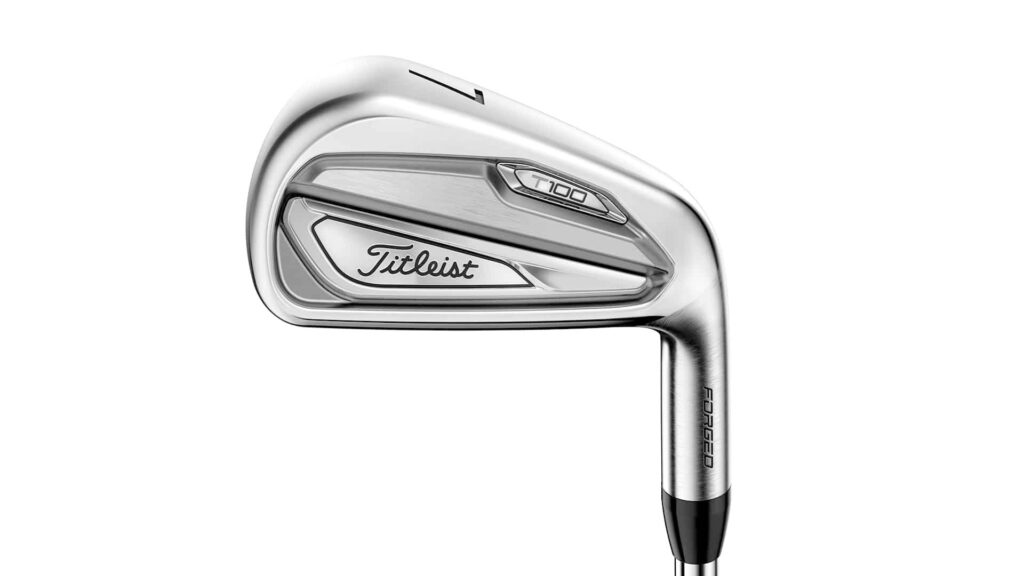
Refined Cavity back
T100 – A new term in my vocabulary; a refined cavity back. Technically, this club is classed as a cavity back since it has metal removed from the back. However, it’s slim face grants the precision of a blade while still offering the stability of a cavity back. Being the most popular iron head used by Titleist sponsored players, this club could be said to provide the best of both worlds when it comes to strike and consistency.
Who uses these: Justin Thomas – *Most used iron on tour*
T200 – Again, this shape is classified as a refined cavity back, but just as the T100 veers towards the blade family, the T200 could be said to be the half-sister of the cavity back family. The T200 offers a solution for the player who is capable of striking it out of the centre but needs a little more stability in the face to build their consistency. If you feel like you can’t consistently strike the T100 but would still like the flexibility of being able to manipulate shots on the course, the T200 might be a winner.
Who uses these: Ian Poulter
Cavity Back
T300 – The most forgiving iron in the line-up. As a result of the weighting system in this head, this face is the most stable and easiest club to hit consistently. Although a player may find it difficult to fade or draw the ball, this club simplifies the game for the player by providing a tool-kit that helps produces a dependable ball-flight.
Who uses these: usually higher handicappers prefer this model
With or without this information about the shape of irons, the most important factor for players to develop an awareness around is strike. By getting fitted, players have the option to try many different iron models, but when results are in question, strike is the trump card. Once you find a club you can consistently strike out of the centre, you can use the different design characteristics of these clubs to your advantage.
CUSTOM FITTING AVAILABLE – BOOK NOW


